
2026 White Coat Ceremony reflects on ripples of impact
Like pebbles dropped in a pond, incoming medical students create ripples that widen far beyond the University of Wisconsin School of Medicine and Public Health.
Students benefit from the unification of medicine and public health in teaching, learning and research. Our statewide campus and our partnership with UW Health University Hospitals and Clinics mean more opportunities for hands-on learning, collaboration and engagement.


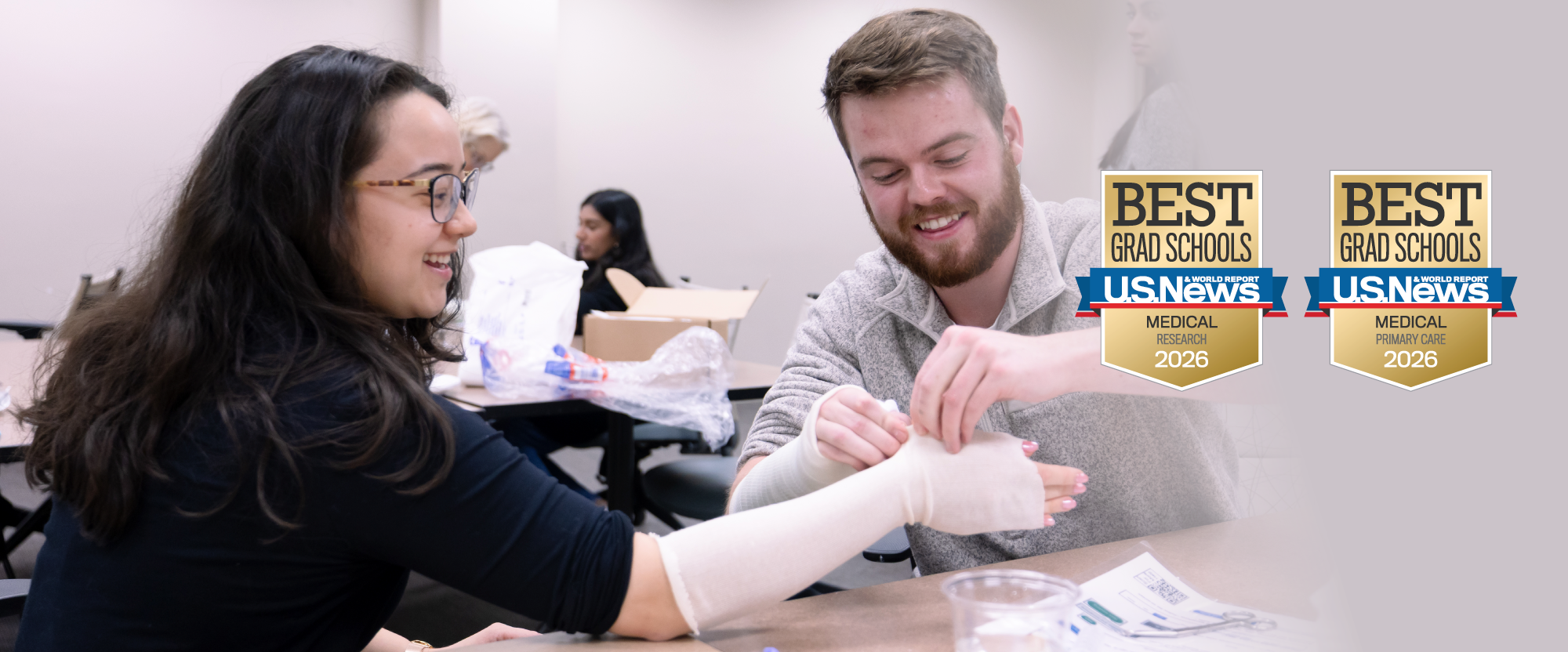
Our MD program is ranked Tier 1 in Primary Care and Tier 2 in Research in the 2026 U.S. News & World Report rankings. We are a national leader in preparing physicians who serve where they are needed most — ranking 18th for the percentage of MD graduates practicing in rural communities, 48th for graduates entering primary care, and 63rd for those working in medically underserved areas. By educating physicians who choose these critical practice settings, we are helping to address the nation’s growing primary care physician shortage.
School of Medicine and Public Health in the country
Health professions programs + 27 PhD and MS graduate programs*
Departments and 25+ centers and institutes
Clinical training partners in Wisconsin
Extramural research funding
Faculty in clinical, basic and applied science
* Including 8 affiliated programs
We are advancing health and health equity through remarkable service to patients and communities, outstanding education and innovative research.
The Neighborhood Atlas® maps degrees of socio-economic disadvantage, which can affect health outcomes.

Like pebbles dropped in a pond, incoming medical students create ripples that widen far beyond the University of Wisconsin School of Medicine and Public Health.

Dr. Brigitte Smith received a $1.1 million precision education grant from AMA to build a platform that will help vascular surgery training programs analyze residents’ and recent graduates' performance data.

No cure exists — yet — for Alzheimer’s disease, the brain disorder that slowly destroys memory and thinking skills, along with the ability to complete daily tasks. But dozens of researchers at the University of Wisconsin–Madison, many of them within the UW School of Medicine and Public Health, are working on ways to prevent, slow and cure the disease.
A University of Wisconsin–Madison research team has shown that an engineered molecule can override a genetic error that causes a rare but devastating form of inherited childhood blindness, restoring the missing protein and recovering visual function in patient-derived cells and in a mouse model of the disease.


We are proud of our long history of innovation and translational research. From microscopy to medical informatics, from cancer research to kinetics and rehabilitation, our investigators are making key discoveries that lead to better treatments.
The School of Medicine and Public Health has a deep and profound commitment to creating belonging for everyone, both as an end in itself and as a valuable means for improving health outcomes.
Social impact and belonging mission
In keeping with the Wisconsin Idea, our engagement extends across the state. Through affiliations with UW Health, hospitals, and rural and urban clinics, students and faculty participate in education and research and improve the lives of the people of Wisconsin and beyond.
The Wisconsin Partnership Program funds education initiatives, research and community health programs targeting the state’s vital health needs.
The borders of our campus extend to the entire state. Medical students learn from hundreds of volunteer physicians at hospitals and clinics throughout Wisconsin.
UW Health faculty physicians care for patients at University Hospital, Carbone Cancer Center, American Family Children’s Hospital and other regional hospitals and clinics.
Wisconsin Medicine is the philanthropic partnership between the UW School of Medicine and Public Health, UW Health and donors like you.